Sunday, March 18, 2012

Abercorn 1, Camera 0

As I reviewed my photos from this year's St. Patrick's Day parade, I couldn't help noticing inherent irony. I go for two reasons:  1) to see my first born son march with the BC cadets, and 2) to see the people I know marching with their families or riding on family/business floats.

So for one day of the year, I cook all day on the 16th, purchase various beverages, pack three or four coolers, secure a parking spot at a friend's house, lug said coolers and beach chairs six blocks to our painstakingly saved parking spot at Abercorn and Hull so that when I see people I know walking down the street wearing green--the same people I see other days of every week--I can wave my arms and yell,
"Hey! Hey!"
before running out in the middle of Abercorn and taking their photo. Nine times out of ten, because so many other spectators are doing the same thing, they don't even know I'm there.  

Then, I park myself on the curb amongst many other mothers of BC cadets, and when I see the BC banner round the corner of Lafayette Square, I run up the street a block and a half so that I can take about two dozen shots of my son as if I'll never get another photo of him in my life. 
One shot isn't enough. I have to get every angle. I become as camera crazy as the paparazzi on Oscar night. And not only that, but I have to get photos of the other cadets because I know their mamas want photos of them too. I somehow forget that other people in the world own cameras, and it's up to me to make sure all the other mothers have for posterity images of their lipstick laden boys.

And thank goodness other people did have their cameras because just as I was asking Kevin McCarthy to take my photo with Master Sergent Osario, I dropped my Fuji S1000 on the pavement, making pieces of plastic and AA batters go flying. Sabra said that from afar, they looked like confetti. Fortunately, the photo card was unharmed, but for the rest of the afternoon, I was relying on the kindness of others for parade pics.
 

This year's event was even more frenzied because it was on a Saturday and the weather was beautiful and more than a million people had descended on downtown Savannah for the event. Two of them were Sabra and Martin Neff, who spent the weekend with us and joined us on the corner of Abercorn and Hull for the four-hour long parade. Michael Tucker stepped out of the parade to have a beer and say hello, and he eventually decided not to get back in the parade, but just stay with us and be a spectator. The Autry family joined us on our truck, as did Bill Sharpley, It was a fun, fun day.

  
 And just think: Next year we get to do it all again! Can't wait!


Saturday, March 10, 2012

Dress Rehearsal

Although Savannah's St. Patrick's Day parade is always a blast, the Remlers have come to enjoy just as much the dress rehearsal:  Tybee's St. Patrick's Day parade, which always occurs on the Saturday prior to March 17th. Today we loaded up our cars and drove down to 10th Court to join JoJo and Pop Pop on the sidewalk of Butler Avenue.


At first, we worried the northeaster would blow us indoors in spite of the beautiful blue sky. But once we settled into our seats in the sunshine, we warmed right up. Even better, the breeze blew the gnats away.

For several reasons, Tybee's parade is a joy:

  • It's an hour long, which is a nice difference from the Savannah parade's three to four-hour long show. 

  • The crowd is much smaller. And although it grows each year, it's still small enough that we can show up about an hour ahead of time and know we'll have prime viewing spots right at the top of the lane.

  • Also because of the small crowd, we're still allowed to run into the street and shake the parade participants' hands. And those marching in the parade can still throw candy and beads to the children (young and old).

  • Every now and then we get invited to a wedding party.

  • Every now and then we get to hug a pig.

  • Every now and then, we get to jump into Matt Daniel's pedi-cab and ride along with him. And every now and then, Matt dresses up like Evel Kenevil.

Who doesn't love a parade? What's more, who doesn't love a parade starring the Beach Chair Brigade?

To me, even the Macy's balloons on Thanksgiving pale in comparison to Tybee's coastal hometown fun. And it gives us a chance to warm up our parade going skills prior to the Big Green Day!

Saturday, March 3, 2012

Lawson Baked Davis's Birthday Cake

Knowing how much Davis loves Star Wars, and always willing to make something chocolate, Lawson decided to make his brother an R2D2 birthday cake. He started on it Friday night and finished it Saturday morning.

The project started by finding an instructional video on YouTube: Even though this video is in hyper-speed, Lawson thought he could follow it enough to make a cake of his own. In case anyone is interested in making this cake, here are some instructions in real time:

1. Make some cakes. Lawson's not an overachiever. He's not averse to using a cake mix. In fact, for this project, he used two boxes of Betty Crocker's chocolate fudge cake mix, which earned his school four Box Tops for Education. So Lawson's not only a generous brother, but a philanthropic student as well.


Both of my children love the opportunity to operate a machine, so Lawson broke out my Kitchen Aid mixer, which actually was due for some exercise. 

2.  Bake the cakes. Lawson used three 8" round cake pans for this project, and he baked them for thirty minutes at 350 degrees. That gave him a little break to join his brother in front of the TV. 
After all, one should always make time for an episode of "Hillbilly Handfishing."

3.  Once the cakes were done, he had to cut them  and shape into an R2D2 figure. He used icing to hold the different layers together and pieced the cake together on a cutting board. 
Then he spread icing over the top to smooth out the spaces between. His little R2 robot served as a model. 

3.  Then he made the legs out of Rice Krispy Treats, which he cut to match the angles of R2's little robot wheels. 

4. Next, Lawson iced the whole cake with white icing to make it look more R2ish. Chocolate is his favorite flavor, but he still opted for more authenticity. By the time he had the whole cake covered, it looked like a little mummy.

5. With blue and black icing, along with a blue sugar sheet, Lawson added the accents to turn that little iced mummy into the beloved Star Wars droid. 
I think Lawson's ready for Ace of Cakes! I hope Davis realizes what a cool brother he has. We'll be breaking into this tasty pastry tomorrow night when we have Davis's birthday dinner. 

Now, I wonder what cake Davis will bake next month when Lawson turns 13...

For the Reader's Digest version of Lawson's artistic process, you can view the following video:
Make your own slideshow with music at Animoto.


Thursday, March 1, 2012

Davis Remler Turns Eighteen

I am now the parent of an adult. Where did the time go?

Click to play this Smilebox greeting
Create your own greeting - Powered by Smilebox
Free digital greeting card customized with Smilebox

Monday, February 27, 2012

Nancy the Fashion Critic

Many thanks to the Academy Awards for ending the program before midnight. Although I'm a little bleary eyed this morning, I'm not cross-eyed from fatigue. Kudos to Meryl Streep, Octavia Spencer, Christopher Plummer, and all the other winners last night. Now enough of that. Let's talk about what people were wearing because I think that's more fun.

As I watched the preceremonial red carpet, I was a little surprised not to see any backward tuxedos or swan dresses, but at the same time Bjork and Helena Bonham Carter were no-shows this year.Still, Hollywood's elite gave us much to talk about. I'll start with the fashion winners:

My highest scores go to Octavia Spencer and Melissa McCarthy. Spencer has looked lovely all during the awards season, and she remained consistent last night in a pale, sequined, form-fitting Tadashi dress. She demonstrated that a woman can be curvy and beautiful at the same time. McCarthy's dress was a refreshing change from her Golden Globes gown, which, to me, was dowdy and tent-like. But last night her crepe number with a jeweled collar and belt glammed up her figure. Both women got A's in my book.
Octavia Spencer

I also give an A to Natlie Portman's strapless red vintage gown. Paired with a v-shaped diamond necklace, her outfit should have worn an award itself. And Viola Davis's green column dress with her natural hair do was stunning. I almost didn't recognize her. Ditching the wig took ten years off her.

Glen Close and Meryl Streep looked okay, but each woman's choice had one aspect to it that made it a little too much. Glen Close, for instance, seemed to be invoking her character Albert Nobbs. Her sleek black fish-tail gown paired with a jacket made her come across as boxy and a little overdone, as if she couldn't decide whether to wear a tux or a gown so she picked both. 

As for Meryl Streep, I was relieved that she wore a design that flattered her figure, a huge step above the disaster that was her Golden Globes dress. In gold lame, she definitely looked like a movie star, but she also looked like Oscar himself. I wondered if those sitting around her felt compelled to don sunglasses. 

Close

Streep

Both actresses earn A's for their work, but in my book, their fashion choices earned B's. 

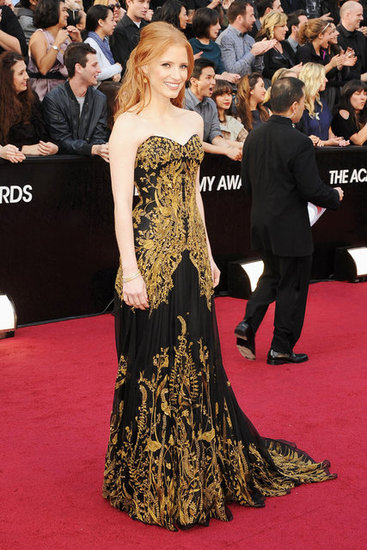
B- goes to Jessica Chastain. I think I'm a voice alone here. Fashion critics on the news are praising Chastain's gold and black gown, but when I first saw her on the screen, I wrote in my notes, "Buckingham Palace called. They want their tapestries back."
Chastain

A few actresses earned C's in my book. Rooney Mara, for instance, chose a gown that didn't suit her figure, and her hairstyle was too severe for my taste. With her pale complexion and her lean form, this gown make her look like she'd broken into her mother's closet to play dress-up. 
Mara

Jennifer Lopez left me wondering what she was thinking. Again, many fashion critics disagree with me, but this sunburst texture in her fabric, and her sleeves gave the same undecided impression as Glen Close's dress. Sleeves? Sleeveless? Why not both? Here's why not:
No thanks.

In spite of my pickiness with respect to these actresses' styles, only one woman made me ask, "What was she thinking?" And she wasn't someone the paparazzi would clamor to see. Mrs. Colin Firth (I don't even know her first name) earned a D in my fashion grade book. Her red gown earned one point just for covering her up, but to me it looked like a baby doll nightie had sex with an apron. Good thing she didn't have to go on stage.
She is a lovely woman, but the dress has got to go.

Of course, the women are always the targets of the fashion critics, but the men deserve some commentary as well, especially in the shave and haircut department. Brian Grazer, the producer of the Oscars ceremony, looked like he'd stuck his finger in a power outlet. I'm sure there was a dressing room with a comb around there somewhere. Then there was Brad Pitt. Although Angelina Jolie looked like a million bucks, Brad Pitt looked like he threw a tux on five minutes before the ceremony. Would a shampoo and cut have killed him? 
At least Christopher Plummer shaved and combed his hair prior to his big night, but his velvet tuxedo raised my eyebrows. Maybe he pulled it out of his 1973 closet:
Velvet. Hmm. Well, he's 82. He can get away with it. 

By far, though, this was my favorite Oscar gown of the year:
I'm talking about the one in the middle, of course. 
Movie star turned mother superior Dolores Hart wen with the no-fuss approach. With this choice, she didn't have to worry about her hair or figure. And I heard it was a brisk night, so she was also warm enough. Good choice!


Sunday, February 19, 2012

Hanway's Famous Invention: The Umbrella

The weather map's been mighty colorful this weekend:


And this morning, as the Remlers made their way to church, then to breakfast, then to the grocery store in the middle of a thunderstorm, I began to ponder then handy device that is the umbrella. 


"It's hard to improve upon the umbrella," I observed on the way home from the Publix. "Think about it. It's been around for centuries, and it hasn't changed very much."

"Really?" Stephen asked. "It's been around for centuries? When was it invented?"

"I don't know," I replied, "But I know people used them in the 1800's. That's centuries ago. Someone out there decided to carry around a little roof over his head to keep himself dry, and we still do it today." 


Then I started to think about all the other technological discoveries that have been improved upon. Take the button, for instance. According to James Burke's book Connections, the button was invented in the fourteenth century (as was knitting): "Both buttons and knitting contributed to closer-fitting clothes that were better at retaining heat. The effect on mortality can be seen in contemporary changes to what was said in wills:  children were expected to survive, and provision was made for them" (161). Hence, because of the button, we all live longer. But over time, we've developed ways to improve upon the button. We now have the snap, the buckle, the zipper, even velcro, all inventions to make fastening more secure and easy. 

Then, of course, there's the fireplace. It's been around almost as long as the fire, but the invention of the chimney changed life as we know it. Before the chimney, "there had been but one central hearth, in the hall during the winter, and outside in summer. The smoke from the central fire simply went up and out through a hole in the roof" (Burke 157). However, once the chimney was discovered, "the center of the room was no longer the only safe place for the fire" (159). People could heat individual rooms, and thus they began to add to their houses. What's more, they began to separate the social classes. But that's just how indoor heating has affected civilization. Just think about how we've improved upon the fireplace over time. True, I still have one in my living room, as many people do, but I don't depend on it for heat. I have my HVAC for that. Instead of depending on wood or coal, many contemporary households use gas-powered ersatz logs, what Davis at five years old termed "the plastic fire." Even chimneys aren't necessary as ventless fireplaces now allow homeowners to enjoy a romantic flame without the inconvenience of that bothersome smoke.  


These days fires are more recreational than essential.


But the umbrella, on the other hand, hasn't changed much since its invention. The materials are different, but the concept is generally the same. Unfortunately, James Burke did not expand upon the umbrella in his captivating book. So I did some online research to find out what I could about this handy invention. I expected to discover that it was at first invented by the Chinese and then Europeans borrowed the idea and called it their own. Actually, I was not far off the mark. 

Thank goodness for William Sangster, who wrote Umbrellas and their History (available in electronic form under Project Gutenberg)! According to Sangster, "The origin of the Parasol is wrapped in considerable obscurity. Some profound investigators have supposed that large leaves tied to the branching extremities of a bough suggested the first idea of the invention. Others assert that the idea was probably derived from the tent, which remains in form unaltered to the present day." But the umbrella itself can be traced back to the ancient Middle East:  "In the Ninevite sculptures the Umbrella or Parasol appears frequently."  Its primary use, however, was to provide shade, not shelter from rain. It was a sign of prestige, even royalty, and continued to signify such as its use spread across Europe. 


However, the umbrella as we know it, the rain guard, is credited to an Englishman named "Jonas Hanway, the founder of the Magdalen Hospital," a philanthropist who dared to carry one in public. Apparently, before Hanway broke the humiliation barrier, folks were embarrassed to be seen walking in the rain under their own personal roofs. However, Hanway, who was known for his advocacy of chimney sweeps and prostitutes, was pale complected and in ill health. Hence, the umbrella not only kept him from the sun's dangerous ultraviolet rays but also kept him dry. 

When it was invented, the umbrella weighed more than ten pounds, probably another reason people were reluctant to carry it around. It was made of whale bone and wood, and often men used them as walking staffs as well as portable roofs. Over time, modifications have improved upon the umbrella. In the late nineteenth century we saw the invention of the self-opening umbrella. Later came the development of the pocket umbrella. 

And as plastics eventually dominated the manufacturing industry, the dome-shaped transparent umbrella served to keep ladies dry while also allowing them to see where they were going: 
I always thought such models required windshield wipers.
 
But the essential concept remains the same:  holding a little roof over one's head. So here's to Jonas Hanway and, if not his invention, at least his remarkable bravery to weather (no pun intended) the hoots and jeers of his soaked contemporaries as he remained dry under his portable shelter. I'm especially thankful for him today.